


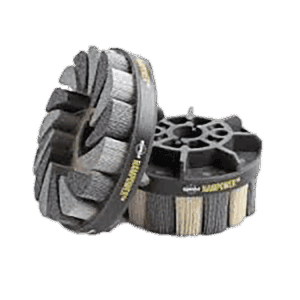


Spot Type Disc Brushes
Spot disc brushes are used for general purpose edge cleaning and surface finishing applications. The spot style is an economical option for light deburring applications when short cycle times are important. They provide greater flexibility and can get into small holes and gaps with ease.
| Grit Selection | Initial Ra Value |
| 80 | 1.4 – 1.5 |
| 120 | 1 – 1.4 |
| 180 | 0.7 – 1 |
| 320 | 0.6 – .7 |
BRUSH DIAMETER SELECTION, COVERAGE OF THE ENTIRE PART
Part Coverage: The ideal brush should be 70mm larger than the part to be worked. If a smaller brush is required due to clamping arrangement constraints, the brush centerline should be aligned to extend at least 35mm from the targeted corner.
Tool Working Path: The brush must rotate at full speed and continue rotating until it separates from the part and completes its path.
Direction of Rotation: The brush rotation direction should be opposite to the burrs created by the cutting tool.
Recommended process parameters.
RPM
Brushes should be operated at speeds lower than the maximum speed listed in MSMFS to prevent overheating and nylon contamination on the surface. The maximum rotation speed marked on the brush is not the appropriate operating speed. It is recommended to stay below 2,500 rpm for dry applications and below 3,500 rpm for wet applications. A 150mm diameter brush is more effective at 1,400 rpm than at 2,800 rpm. Excessive speed, especially with long-bristle brushes, causes bristles to bend and bounce on the part. Generally, high rpm increases deburring aggressiveness.
Wear Compensation:
It is possible to automate wear compensation in specialized equipment. By using electronic controls to monitor the load on the drive motor, brush pressure can be adjusted to maintain relatively consistent pressure. In standard CNC machines without automatic load adjustments, different methods such as automatic indexing, probe control, or manual adjustment should be used.
Print Depth
| Brush Depth | Pressure Depth |
| Spot Type | 0.381 – 3.962 mm |
| Turbine Type | 0.177 – 2.362 mm |
For fine-wire brushes, the amount of pressure should be adjusted to penetrate up to 10% of the existing wire length and up to 5% for thick-wire brushes. Generally, by reducing the rotation speed and increasing the pressure, the brush wire fits smoothly into the part lines. In this way, the brush wire does not hit the part and bounces on its surface, but rather picks up burrs along the surface and corners of the part, as if it were a file. This form of brushing also increases the strength of the brush.
PACING
| Material | Feed Rate |
| Non-ferrous | 2,032 m/min |
| Cast iron | 1,524 m/min |
| Mild Steel and Cast Iron | 1.27 m/min |
| Stainless and Alloy Steels | 0.762 m/min |
| Titanium and High Nickel Alloys | 0.762 m/min |
The feed rate is determined by many factors, such as burr size, workpiece material, surface contours, and roughness requirements. Contoured surfaces should be processed at lower speeds and higher prints than flat surfaces. Initial feed rate of 30fpm and 80fpm is recommended, but final feed rate is application-specific and should be developed based on deburring experience.
Application Guidelines
| For more aggressiveness -Reduce brush length -Use larger diameter brush -Increase grit size -Use high-density bristle brush (Turbine Type) -Increase rotation speed -Increase pressure depth | For less aggressiveness -Increase brush length -Use smaller diameter brush -Use finer grit -Use medium-density bristle brush (Dot Type) -Reduce pressure | For contouring -Increase brush length -Use fine-grit brush -Use low-density bristle brush (Dot Type) -Increase pressure |
| For fine surface finish -Use brush with coolant -Use long-bristled brush -Increase rotation speed | For rough surface finish -Operate brush without coolant -Increase grit size -Use smaller diameter brush -Decrease rotation speed | For Cleaning Marks and Stains -Use brush with coolant -Use small diameter brush -Reduce RPM -Reduce pressure |
While spot types are preferred in general deburring and light-duty surface finish applications, our turbine type disc brushes are used in medium and heavy-duty deburring operations. Both types of disc brushes use ceramic and silicon carbide alloy nylon filaments in an effective combination.